
The Black Hole Explorer: Tracing an Edge of the Visible Universe
Speaker
Date
Time
Place
Online (Zoom)
Abstract
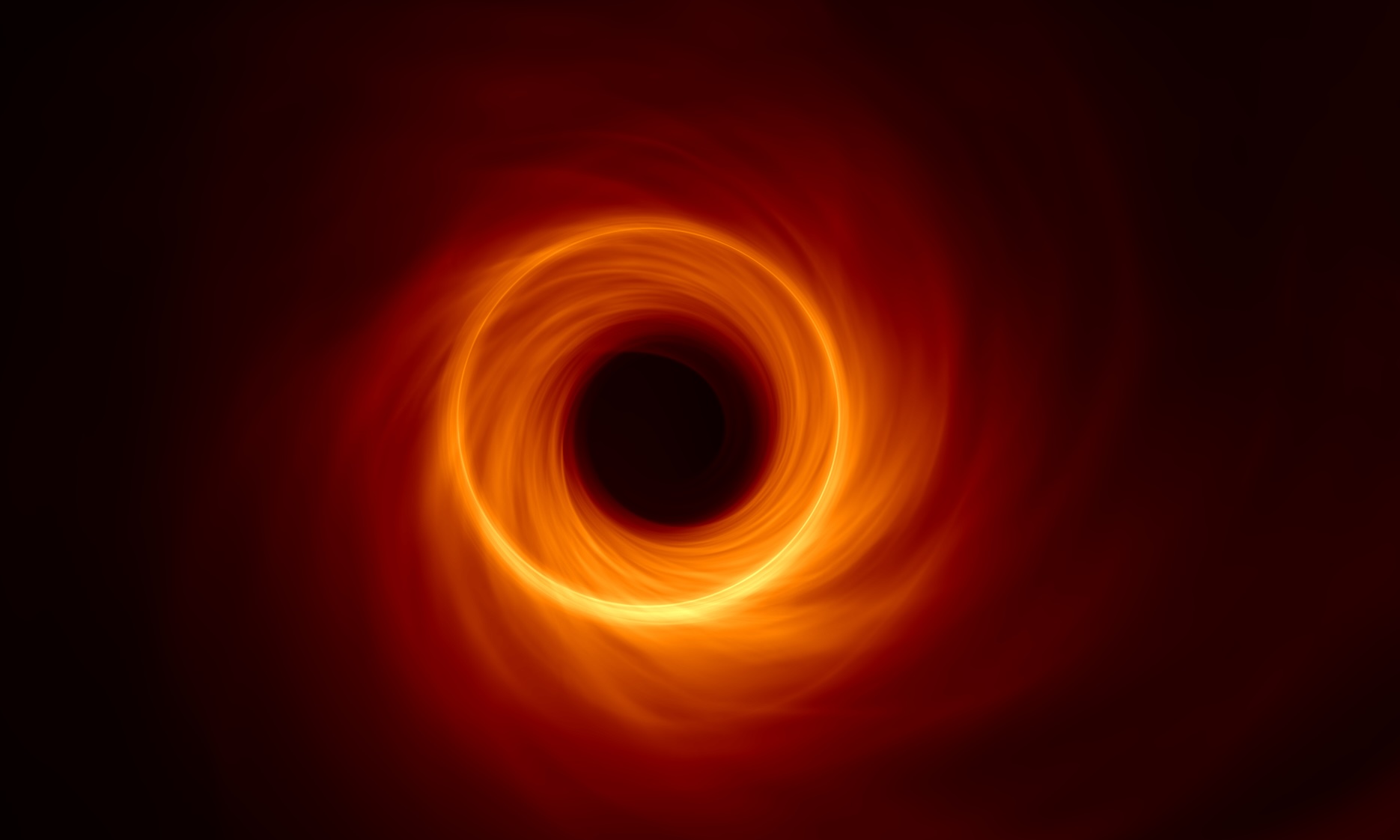
Black holes are the most extreme objects in the Universe. They're regions where gravity is so strong that space and time are warped in dramatic and still mysterious ways. In a 2019 breakthrough, the Event Horizon Telescope captured the first images of a black hole, opening a new window on these once-invisible giants. Despite this spectacular achievement, black hole images taken from the ground remain blurry, revealing only a dark shadow encircled by a glowing, fuzzy donut of light.
I will introduce the Black Hole Explorer (BHEX), a bold plan to launch a radio telescope into Earth orbit that will take some of the sharpest images in the history of astronomy. By creating high-resolution movies of black holes, BHEX will resolve the 'photon ring' traced by light that orbited the black hole and skirted its event horizon — an edge of our visible universe — before escaping to our telescopes. BHEX observations will enable precise tests of Albert Einstein's theory in the strongest gravitational fields, deliver accurate measurements of the space-time geometry, mass and spin of black holes, and illuminate how these cosmic engines power their relativistic jets (cosmic beams that cast the brightest lights in the observable universe).
Biography
Alex Lupsasca is a theorist specializing in black holes, relativistic astrophysics and classical and quantum gravity. Currently a resident scientist at OpenAI, he is the project scientist for the Black Hole Explorer and has been an assistant professor of physics and mathematics at Vanderbilt since 2022. He is a recipient of the Breakthrough Foundation's 2024 New Horizons in Physics Prize and was awarded the 2024 Early Career Scientist Prize from the International Society on General Relativity and Gravitation for his work on black hole imaging. Last year, Science News Magazine listed him as one of 10 "Scientists to Watch" for outstanding contributions to their fields, and the Society for Science awarded him the Jon C. Graff, Ph.D. Prize for Excellence in Science Communication.