
Cosmology in the Era of Multi-Wavelength Surveys
Speaker
Date
Time
Place
Astro-Math Building (R1412)
Abstract
The Universe we observe holds many hidden wonders, most of which we are only beginning to understand. Astonishingly, only about 5% of the Universe consists of familiar "normal" matter, while the vast majority is dark energy and dark matter, whose origins and properties remain mysterious. This talk explores how studying the growth of cosmic structures, such as galaxies and galaxy clusters, provides crucial insights into these enigmatic components.
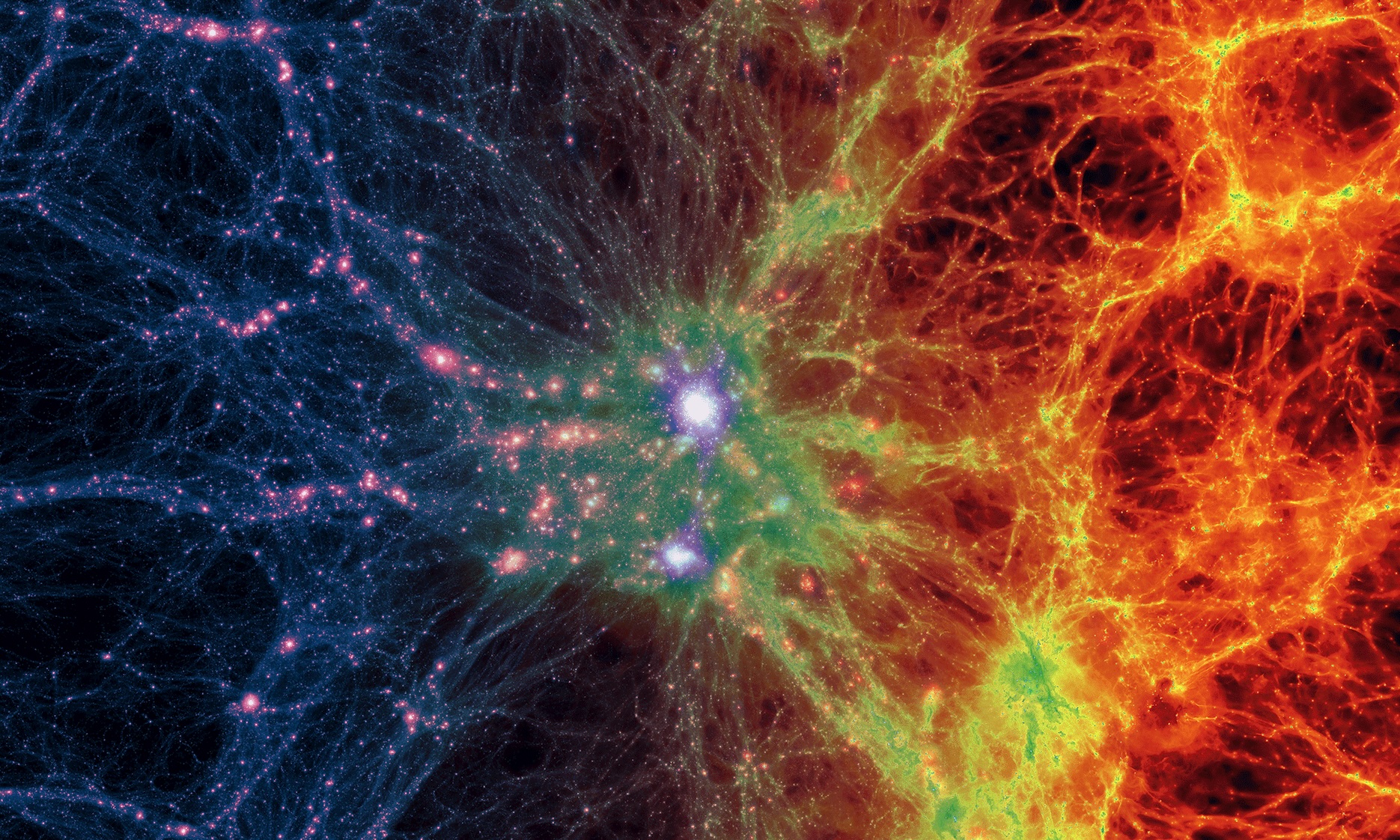
What makes this exploration even more challenging is that much of the "normal" matter is also elusive. Computer simulations have long predicted that most of this "normal" matter exists as a diffuse, ionized gas within large-scale cosmic web structures. Electrons play a central role in probing this matter, as their interactions with light help reveal these structures.
To accurately probe the dark universe, we must first disentangle the gravitational influence of this elusive normal matter from that of dark matter itself. Overcoming this is one of the central challenges in modern cosmology. I will show how the synergy between state-of-the-art computational modeling and machine learning offers a powerful solution. By training algorithms on virtual universes from our simulations, we can teach them to identify the subtle signatures of this gas in real telescope data. This synergy is essential for creating a complete cosmic map and tackling fundamental questions about the nature and composition of our Universe.
Biography
Daisuke Nagai is a Professor of Physics and Astronomy at Yale University. His research bridges theory and observation, integrating cutting-edge computational and data science techniques to explore fundamental questions in astrophysics and cosmology. He earned his Ph.D. from the University of Chicago in 2005, was a Sherman Fairchild Postdoctoral Scholar at the California Institute of Technology, and joined the Yale faculty in 2008.